Harmonic price patterns
Reversal shapes measured by Fibonacci

Read
Most chart patterns are a matter of opinion — "that looks like a triangle". A harmonic pattern is only valid if the Fibonacci measurements line up. That precision is the entire point.
Green Call here! 🦋 Harmonics are five-point reversal shapes labelled X-A-B-C-D, where every leg has to hit a specific Fibonacci ratio. If the ratios do not check out, you do not have a harmonic pattern — you have a squiggle that resembles one. That hard line is unusual in technical analysis, and it is why some traders love these and others find them fussy.
The Gartley: the classic
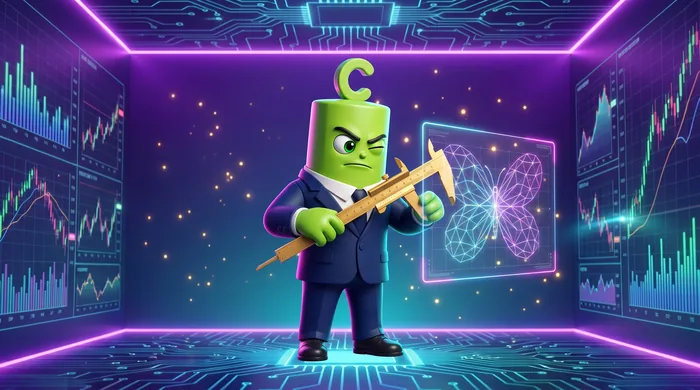
The Gartley is the most famous of the family and the best one to learn first, because every other harmonic is a variation on its skeleton.
Price swings X→A, pulls back to B at about 61.8% of the XA leg, pushes to C, then makes a final leg down to D at roughly 78.6% of XA. Point D is the *potential reversal zone* — where you look to trade the bounce back in the direction of the larger trend.
B sits near 0.618 of the XA leg. D sits near 0.786 of it. Get those two right and you can recognise a Gartley without measuring every other line on the chart.

The harmonic zoo
Same X-A-B-C-D skeleton, different ratios, different animal. What changes between them is essentially one thing: how deep the final D leg runs.
Gartley — D at 78.6% of XA, the balanced classic. Bat — a deeper D at 88.6%. Butterfly — D extends BEYOND X, at 127–161.8%. Crab — the most extreme, D at 161.8% of XA.
They all share the same M or W silhouette on the chart, which is why they are easy to confuse at a glance and impossible to confuse once you measure.

Trading the completion
Here is where most harmonic trades go wrong: assuming that because price *reached* D, it must turn there. It does not owe you that.
Wait for a reaction in the D zone — a reversal candle, a momentum signal, something that shows the level is being defended. Then enter toward the expected bounce and place the stop just beyond D, past the point where the pattern would be invalidated. Targets are usually Fibonacci retracements of the final CD or the whole AD leg.
Draw it, check the ratios, wait for a reaction at D, then enter with the stop just past D. Skip any of the four and it is not a harmonic trade.
The ratios make the pattern. If a leg misses its number and you decide it is "close enough", you have quietly turned a rule-based method into a subjective one — and kept none of the advantages that made it worth the effort.
Unlike most patterns, a harmonic tells you exactly where it is wrong: beyond D. That precise invalidation is arguably more valuable than the entry signal itself, because it makes position sizing trivial.
Precise shapes, precise stops, and no arguing with the tape measure. 🦇