Market Size & Liquidity
Where forex really trades, why the dollar is king, and what liquidity means

Read
The biggest market on Earth has no building, no bell, and no address — just pure electricity.
There is no forex building. No trading floor, no opening bell, no address you could visit. The single biggest market on Earth — trillions changing hands a day — runs as pure electricity across a network of banks. Let’s find out where it actually lives.
The bulk of forex trading happens on the interbank market.
Unlike the New York Stock Exchange or London Stock Exchange, the forex market has neither a physical location nor a central exchange.
It is an over-the-counter (OTC) market: the whole thing runs electronically, across a network of banks and non-bank financial institutions, 24 hours a day. Trade anywhere you have an internet connection.

In an OTC market, participants choose who they trade with based on prices, conditions, and the reputation of the counterparty (the party taking the opposite side of your trade).
The tape is a trader’s word for the live stream of prices ticking by. A deep, liquid market has a busy tape that barely flinches when a big order lands.
The most traded currencies
Here are the most actively traded currencies, by their share of daily turnover (BIS 2025).
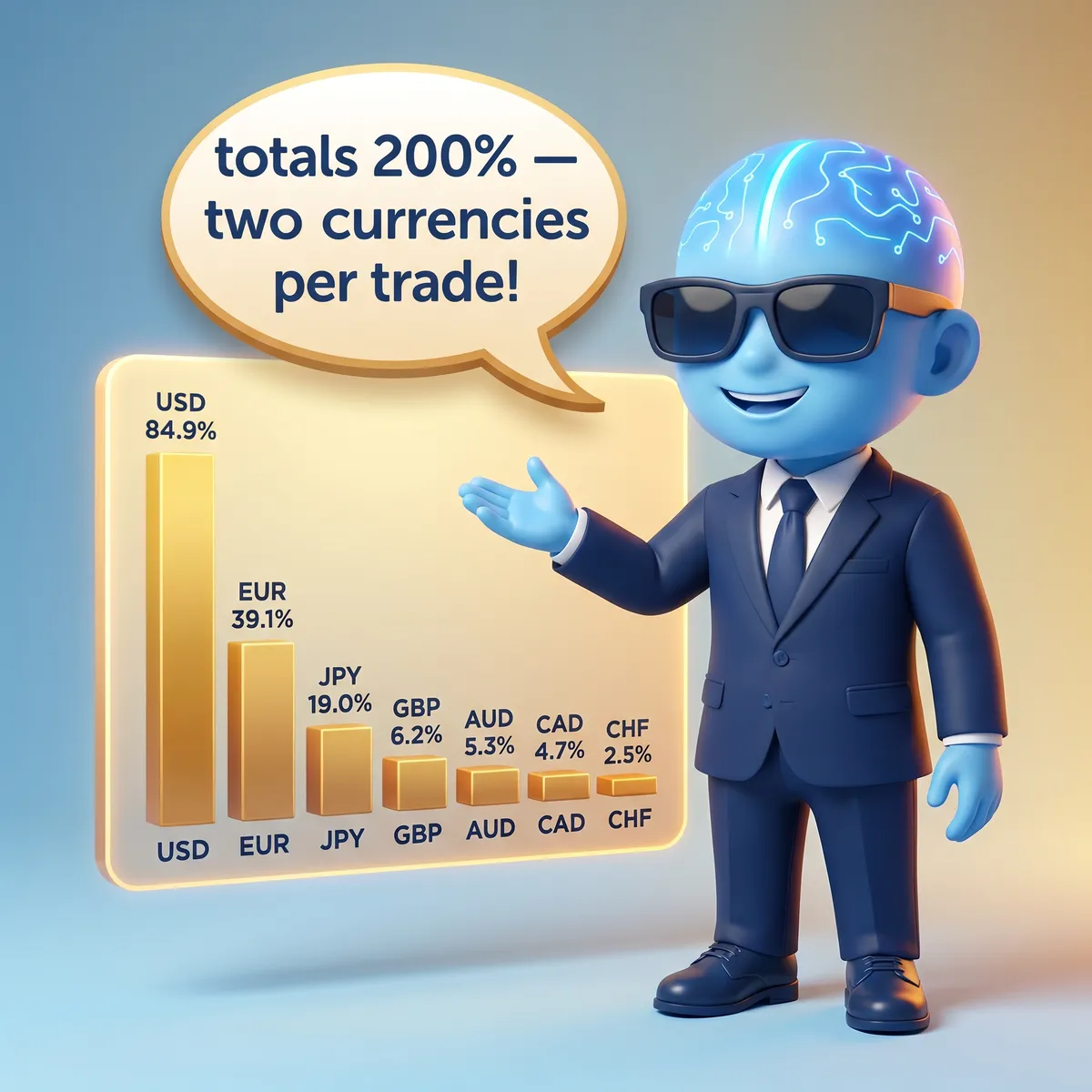
Because two currencies are in every trade, the shares add up to about 200%, not 100% — each currency is counted on its own side of the deal.
The U.S. dollar is the most traded, on one side of 89.2% of all transactions. The euro is second at 28.9%, and the yen third at 16.8%. The majors own the top of this list — and that’s exactly why we start there.
The dollar is king
You’ve noticed how often the U.S. dollar (USD) comes up.
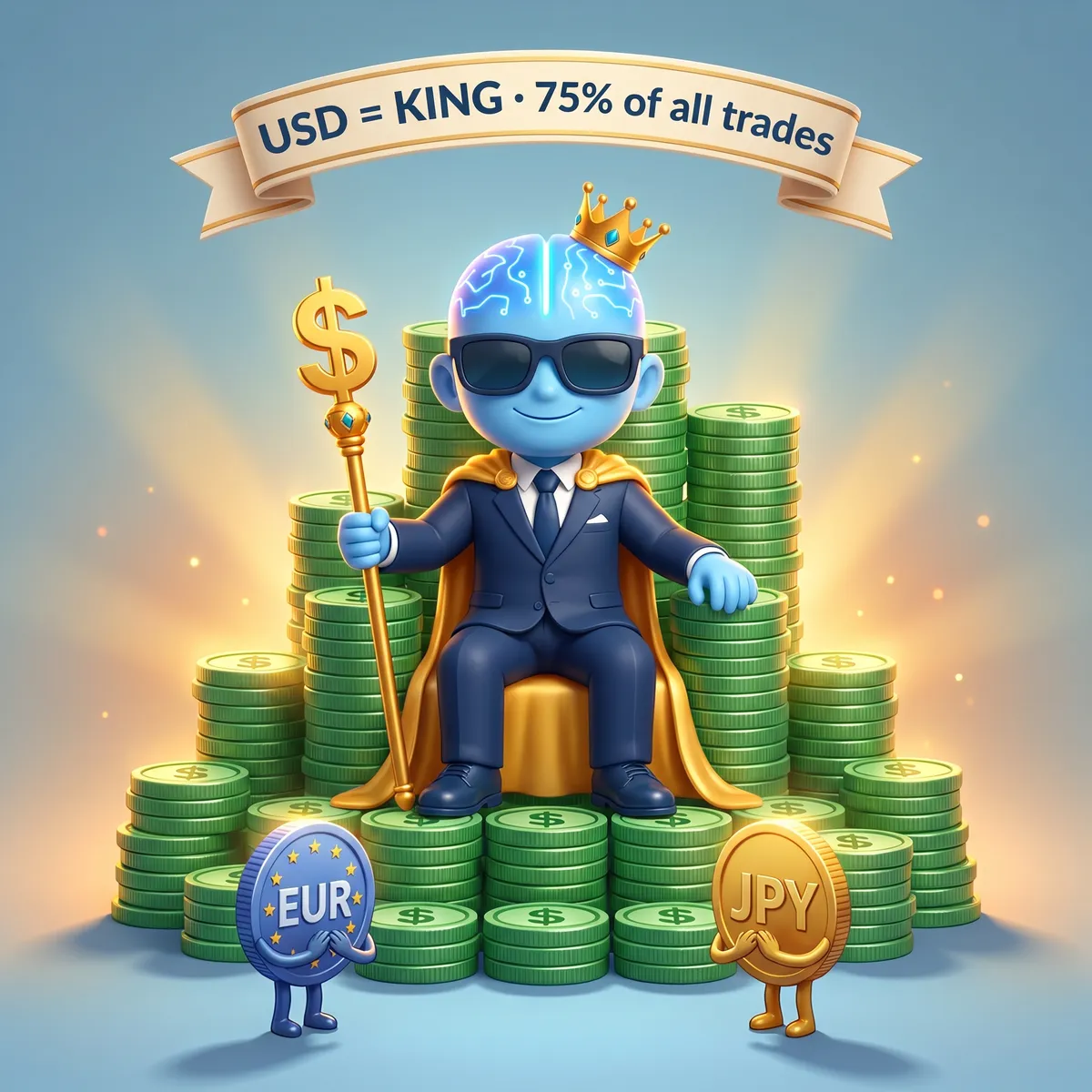
If the USD is one half of every major currency pair, and the majors make up 75% of all trades, then watching the dollar is unavoidable. The USD is king.
It is also about 57% of the world’s official foreign exchange reserves — assets central banks hold in foreign currencies (source: IMF COFER).
Because almost every investor, business, and central bank owns dollars, they all pay attention to the U.S. dollar.
The U.S. dollar is one half of every major currency pair, and the majors make up about 75% of all forex trades — so watching the dollar is not optional.
A few more reasons the dollar sits at the center of the market:
The United States has the largest economy and the deepest, most liquid financial markets in the world.
The dollar is the world’s reserve currency, and represents about half of all international loans and bonds.
It is the medium of exchange for cross-border trade — oil, for one, is priced in dollars (“petrodollars”). If Japan wants Saudi oil, it pays in dollars: sell yen, buy dollars, buy oil.
Speculation & liquidity
The forex market moves money for trade, short-term credit, and hedging against exchange-rate swings. But most of the volume comes from one thing: speculation.
Speculators — traders buying and selling on short-term price moves — make up an estimated over 90% of forex volume.
All that volume makes the market extremely liquid: you can buy or sell a large amount with minimal impact on the price.
For a short-term trader, liquidity matters because it decides how easily a price can move. A liquid market lets huge volumes trade with very little effect on the price. Depth still varies by pair and time of day — more on that in a later lesson on trading sessions.
Forex is an OTC network — no central exchange. The dollar is one side of ~89% of trades and ~57% of world reserves. Enormous volume = deep liquidity = tight pricing for you.
See you on the desk. — AI Mentor