What is Traded in Forex?
Money. Specifically, currencies — and the big eight you’ll meet first

Read
You can’t hold it, ship it, or stack it in a warehouse — yet it’s the most-traded thing on Earth.
You can’t hold it, ship it, or stack it in a warehouse — yet it’s the most-traded thing on Earth. So what exactly are you trading in forex? The simple answer: money. Specifically, currencies.
Nothing physical ever changes hands here, which is what makes the whole thing feel slippery at first. One comparison fixes that.
A currency trades the way a national scoreboard would. Every number a country publishes — growth, jobs, inflation, the central bank’s next move — lands on that scoreboard within seconds, and the price is the running total of what the market makes of that economy.

Buying the Japanese yen is a bet that Japan’s scoreboard will read better than the one you sold against it. Not that Japan is doing well in absolute terms — that it is doing better than the alternative.
Close the position later and the difference between the two scoreboards is your result — in either direction.
Which is the whole idea in one line: an exchange rate is never a verdict on one economy. It is always a comparison between two.
Major Currencies
While there are plenty of currencies you could trade, as a new forex trader you’ll almost certainly start with the “major currencies”.
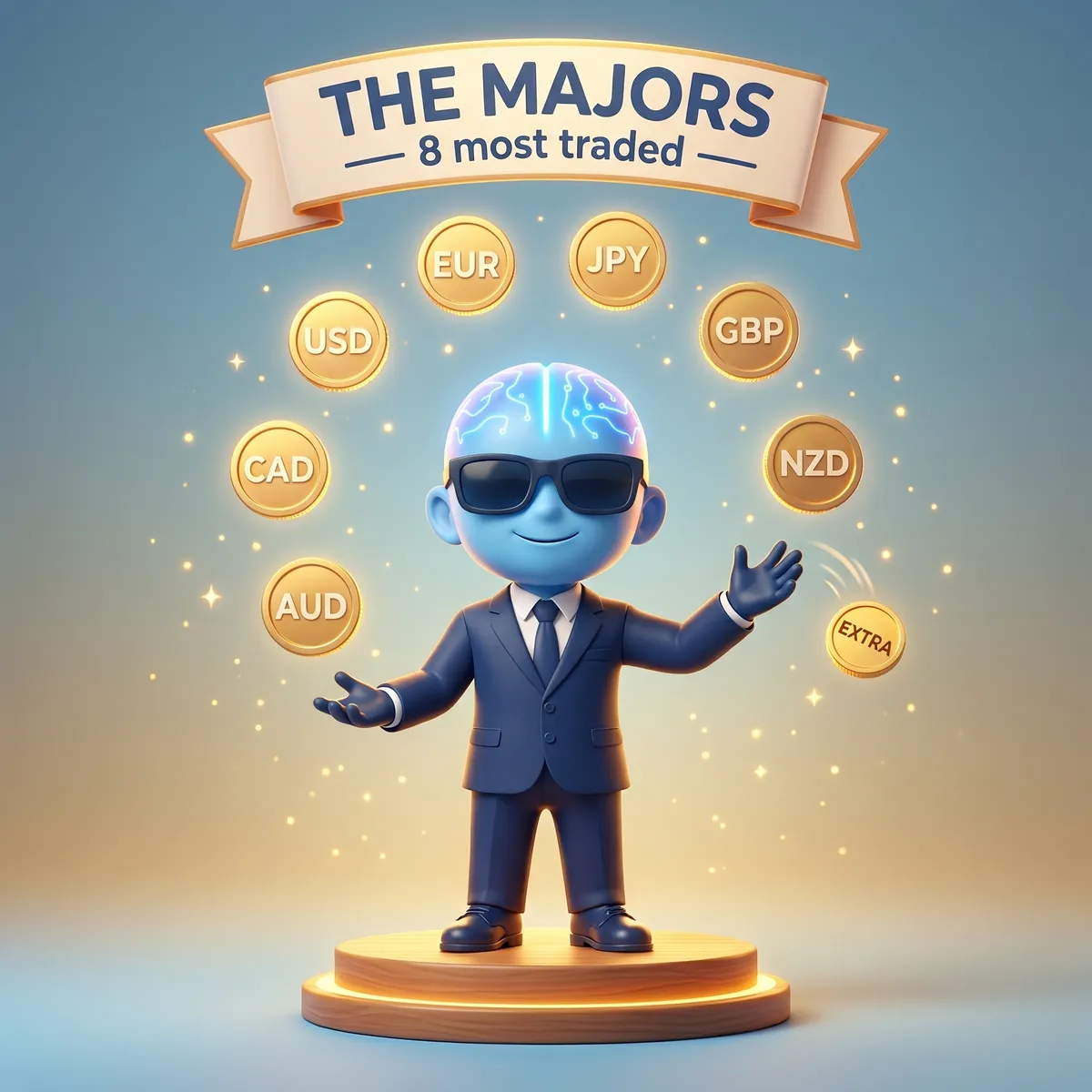
Major is not an official title — it is just where the volume goes. These eight sit behind the deepest markets, which is why they are the cheapest to trade and the first ones you will meet.
Traders don’t all agree on the exact list. Some count only USD, EUR, JPY, GBP, and CHF as majors, and file AUD, NZD, and CAD under “commodity currencies”. To keep things simple, we treat all eight as the majors.
The majors — the eight most-traded currencies. On the desk, “trading the majors” means sticking to these deep, liquid names rather than thinly-traded exotics, where prices jump and spreads widen.
Below are all eight — symbol, country, currency name, and the nickname you’ll actually hear on the desk.
The three-letter code
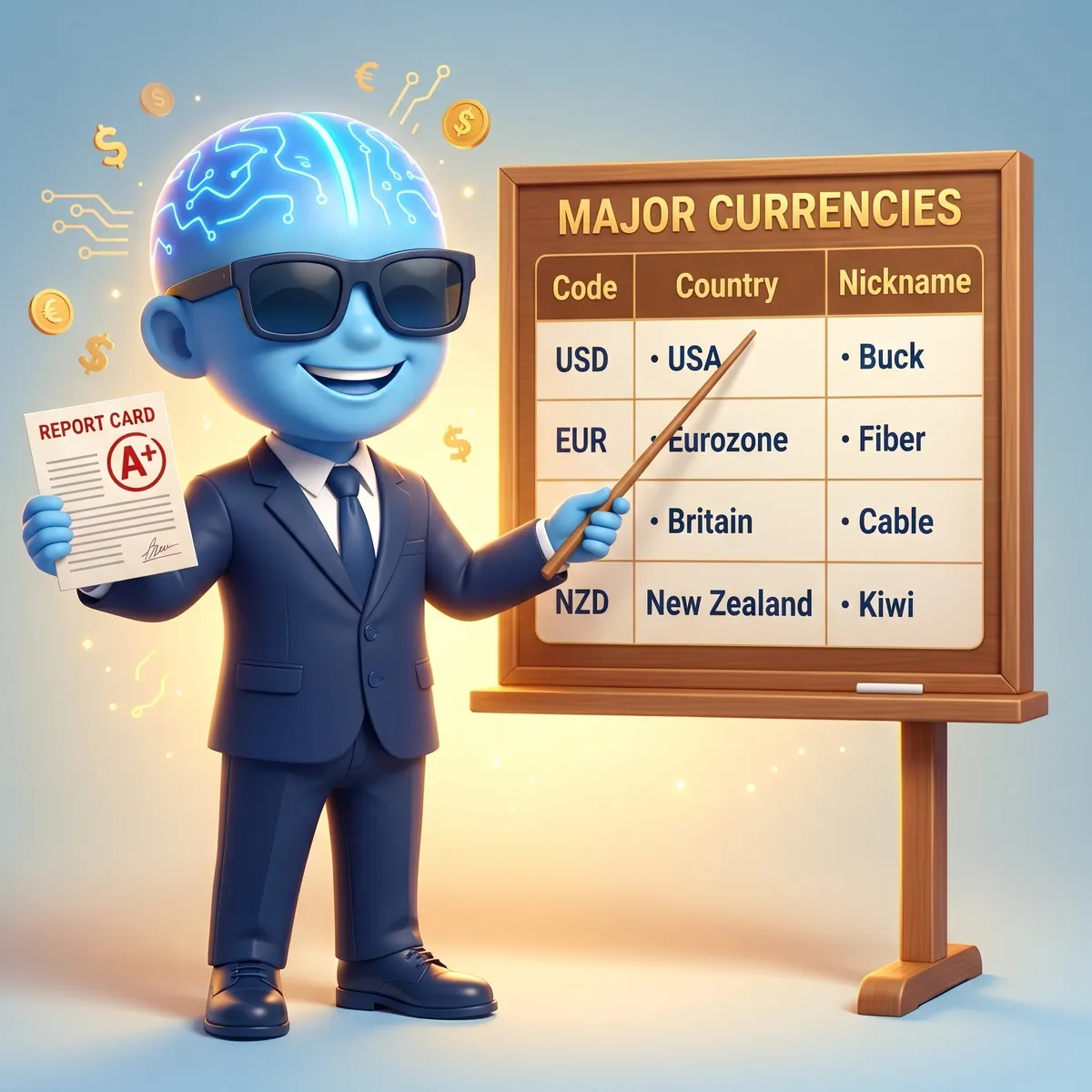
Read a code left to right and it decodes itself: two letters for the place, one for the money. CHF is Confoederatio Helvetica plus franc; JPY is Japan plus yen. Once you see the split you never have to memorise another one.
The standard behind them is ISO 4217, settled in 1973 — which is why a trading screen in São Paulo and one in Singapore show a currency the same way.

Take NZD: NZ stands for New Zealand, and D stands for dollar. Crack the pattern once and every code reads itself.
Twelve centuries separate the ends of this list. The British pound has been money since the 8th century; the Zimbabwe Gold (ZiG) has been money since 5 April 2024.
Every currency has a nickname
Walk onto a trading desk and nobody says “United States dollar.” They say the buck. The pound is cable, the Swiss franc the swissy, the Canadian dollar the loonie, the Australian the aussie, and the New Zealander the kiwi.
Cable — GBP/USD’s nickname dates to the 1860s, when pound-dollar quotes were sent across the transatlantic telegraph *cable*. Traders still call the pair “cable” today.
The dollar collects more street names than any other — greenbacks, bucks, and dead presidents among them — but “buck” is the one you’ll hear on the desk.
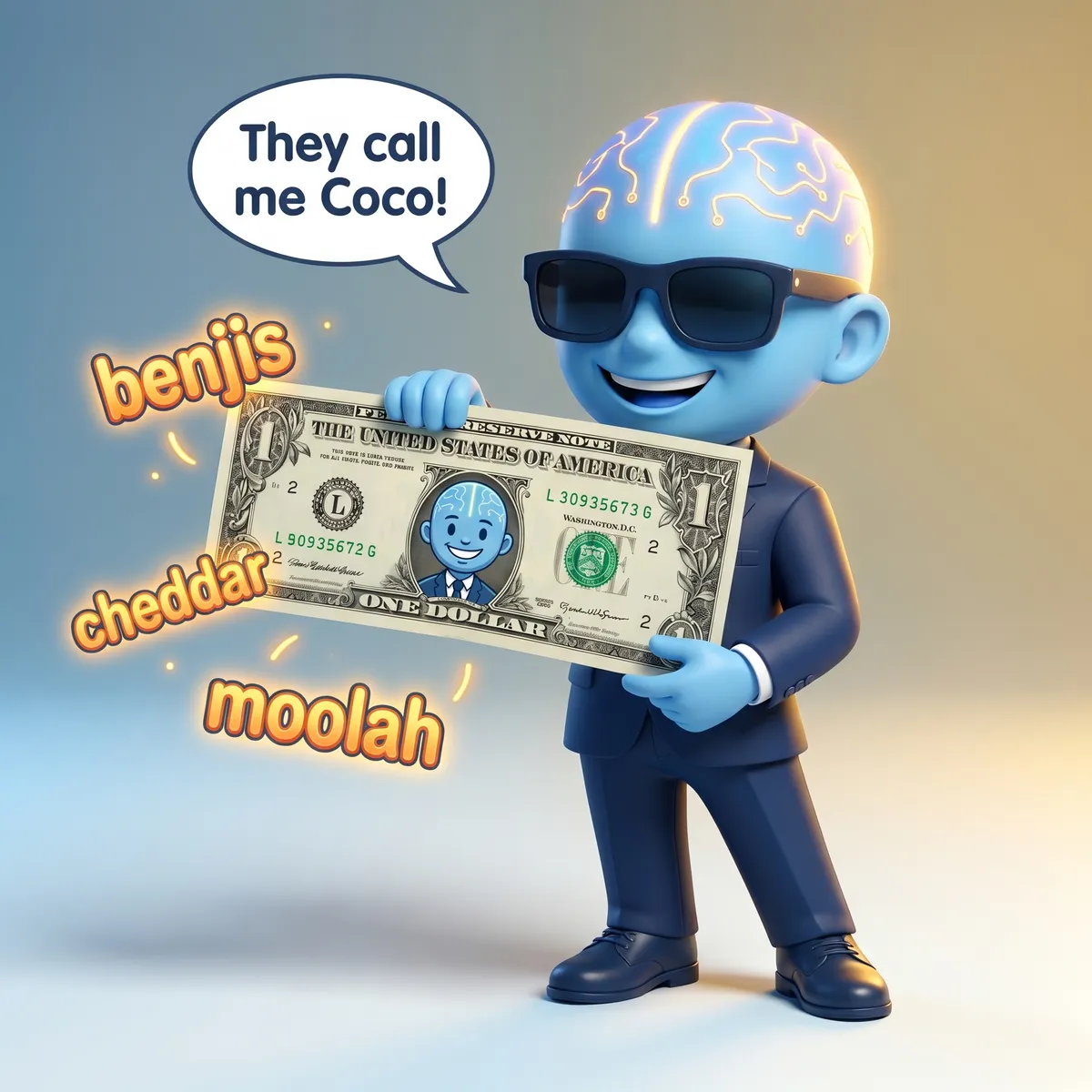
Peruvian traders call the US dollar Coco — short for Jorge, which is George in Spanish, because George Washington is the face on the one-dollar note.
You trade currencies, not goods — buying one is like buying a share in that country’s economy. Start with the eight majors: USD, EUR, JPY, GBP, CHF, CAD, AUD, NZD. Each is a three-letter ISO code — two for the country, one for the currency — and each carries a desk nickname.
See you on the desk. — AI Mentor