The Bid and Ask Price
Two sides to every quote — and the spread in between

Read
You already haggle better than you think — the moment you counter a price, you have quoted a spread.
Picture a bustling farmers’ market. You eye a basket of fresh strawberries and ask the price. “Five dollars,” says the vendor. “How about four?” you counter. He smiles and shakes his head, sticking to his price.
Congratulations — you just met the bid and the ask. The vendor’s price, what you pay to buy, is the ask. Your counteroffer is the bid. Every forex quote works exactly this way: two prices at once.

What are the bid and the ask?
A forex quote always has two sides — the bid and the ask:
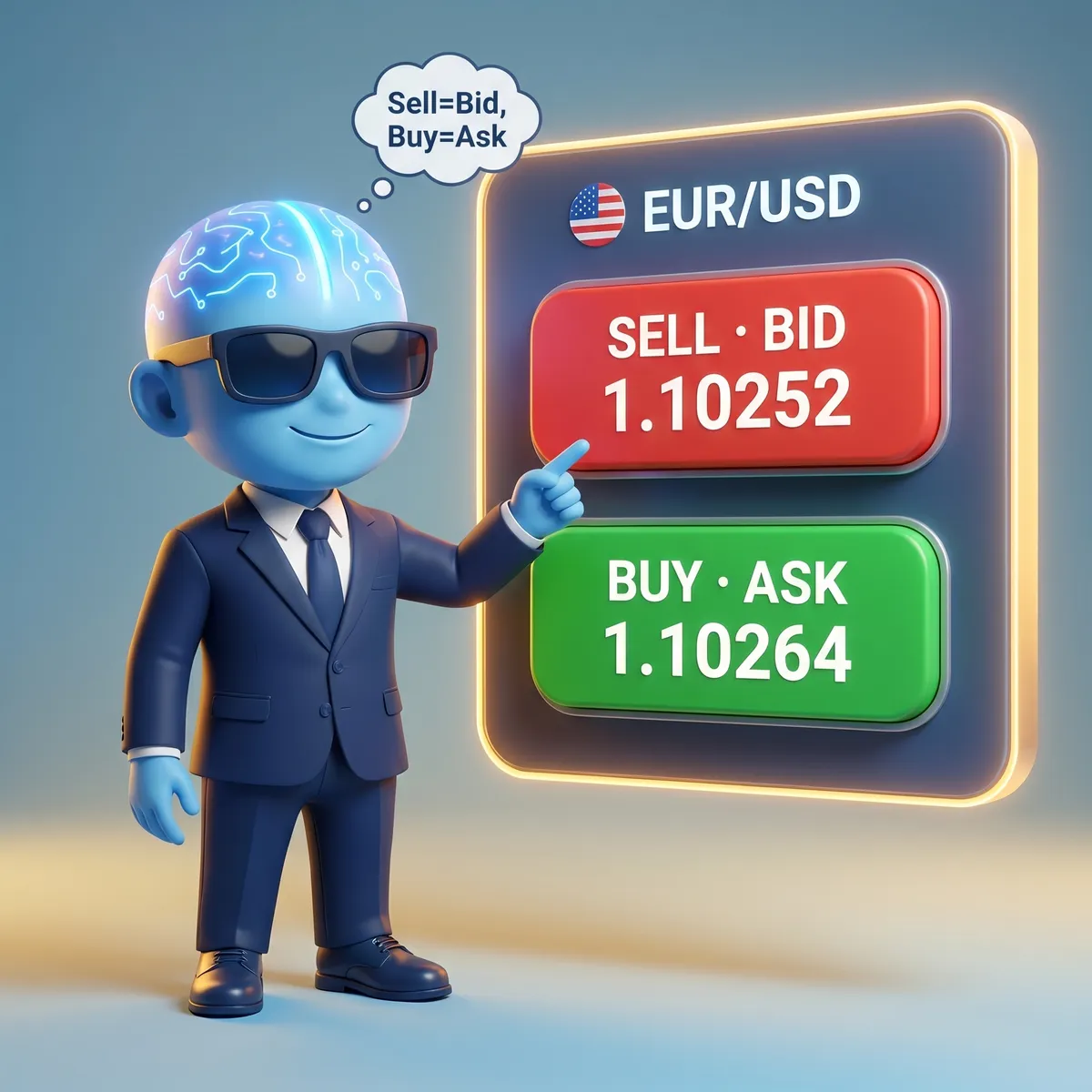
EUR/USD = 1.10252 / 1.10264
• The bid is 1.10252 — the price on the left.
• The ask is 1.10264 — the price on the right.
Some brokers quote a 5th decimal (the final 2 in 1.10252) for extra precision. Those are “pipettes” — fractional pips. You’ll meet them properly in the Forex Lingo lesson; for now, just read the first four decimals.
Bid and ask are the broker’s words, not yours
If the terms feel backwards, here’s the trick: the bid and ask are quoted from the broker’s perspective, not yours.
When you’re buying, you pay what the broker is asking. When you’re selling, you accept what the broker is bidding. The broker always asks a little more than it will bid — that gap is its cut.
Since you want to buy EUR — the base currency — you pay the ask, the broker’s asking price: 1.10264.
If you were selling, you’d take the bid — i.e. “accept the broker’s bid” — which is 1.10252.
To save you the mental flip, most platforms relabel these: they show “Buy” instead of Ask and “Sell” instead of Bid.
The spread
The difference between the bid and the ask is the spread.
That gap is the broker’s revenue, collected on entry whether the trade later works or not. It is not a forex quirk either — every quoted market, from shares to crypto, charges you the same way.
There is no free quote. Every price you’re shown already has the broker’s cut built in.
Example: the used-iPhone dealer
Say you deal in used iPhones. You buy them cheap and sell them dear, and the gap is your profit. A forex broker runs the very same book.
A seller messages you wanting to offload a phone. You quote a BID — the price you’ll pay to buy it. Say $1,000. They take your bid, and the phone is yours.

You immediately list it online. A buyer comes along. You quote an ASK — your selling price. Say $1,500. They take your ask.

You bought at your bid ($1,000) and sold at your ask ($1,500). The $500 difference is the spread — your profit as the dealer.

You are the price taker
Here’s a real platform quote list — bid and ask, side by side, for a range of currency pairs:

When you place a trade with a retail forex broker, you are a “price taker.”
You’re not buying from and selling to other traders, the way you would on a stock or crypto exchange. You’re buying from and selling to a dealer — and the dealer makes its profit by adding a spread, or markup, to every quote.
That’s why retail forex “brokers” aren’t really brokers at all. They’re dealers, working the same book as the iPhone dealer above — there’s more on picking one in the broker guide.
Selling at the bid is hitting the bid; buying at the ask is **lifting the offer**. Either way you cross the spread — and pay it to your broker.
Because you always buy at the ask and sell at the bid, opening and instantly closing a trade already puts you down by the spread. The market has to move in your favor by at least the spread just to get you back to breakeven.
Every quote has two sides: bid (sell) on the left, ask (buy) on the right — both from the broker’s perspective. You buy at the ask and sell at the bid. The gap is the spread, the broker’s cut, and as a retail trader you’re the price taker who pays it.
See you on the desk. — AI Mentor