The 4 parts of an option
Underlying · Strike · Premium · Expiration

Read
Every option ever quoted — call or put, Apple or NVDA — is built from the same four pieces. Learn them once and you can read any option, forever.
The first time you see an options screen, it looks like noise — rows of numbers, cryptic labels, prices everywhere. It’s not. It’s the same four ingredients, repeated over and over.
Think of it like ordering coffee: size, drink, add-ons, cup. Once you know the slots, any order makes sense. Options work exactly the same way — four slots, always the same four.

Read all four as one sentence and it clicks: "the right to trade the **underlying** at the **strike**, for a **premium**, before **expiration**." Let’s take them one at a time.
Meet the four parts
Underlying — the stock the option tracks. If it’s an NVDA option, NVDA is the underlying. The option is just a contract riding on top of that stock’s price.
Strike — the fixed price you’re allowed to trade at. This is your locked-in deal price. Whatever the stock does, your strike doesn’t move.
Premium — the fee you pay to own the option. It’s the price of the deal, not the price in the deal. You hand it over up front to hold the right.
Expiration — the deadline. After this date, the option is done. Use it before then or it vanishes, along with the premium you paid.
Strike vs. premium trips up almost everyone at first. Say it like this: strike = the deal price, premium = the price of the deal. One is what you trade at; the other is what the ticket costs.
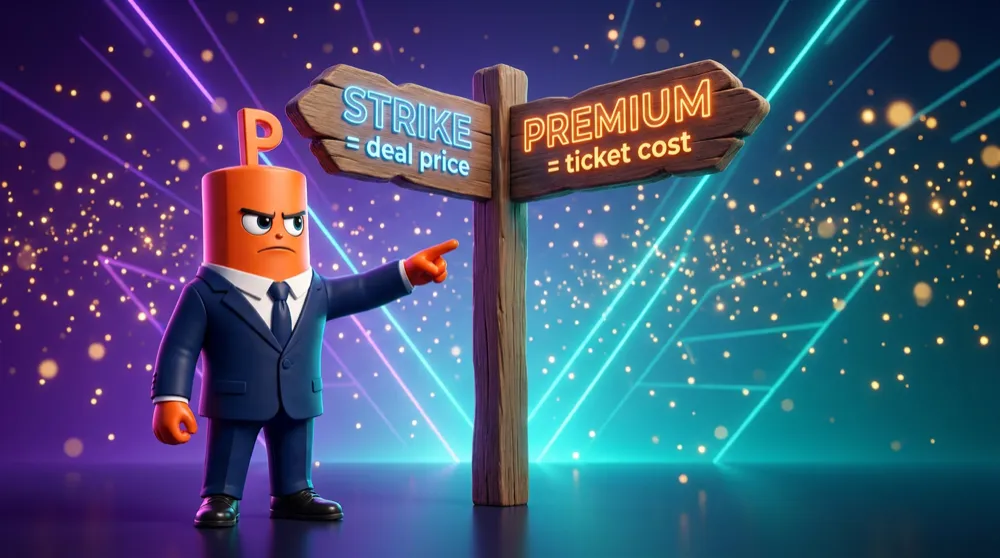
Strike is the price in the deal. Premium is the price of the deal.
Reading a real quote
Traders compress all four parts into a quick line. You’ll hear things like: "I bought the NVDA 100 call for 5, expiring Friday." Sounds like code — until you map it to the slots.
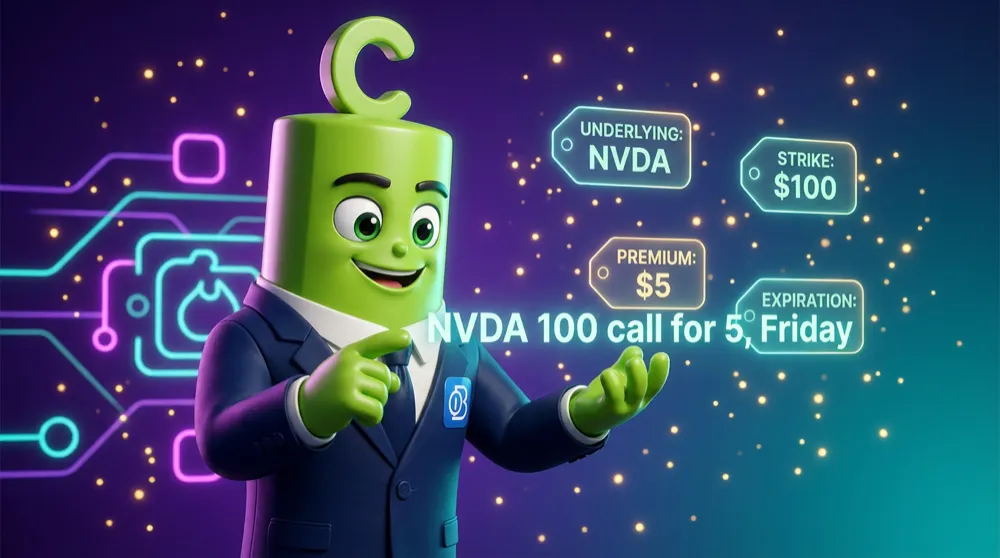
Here’s the decode: NVDA is the underlying, 100 is the strike, 5 is the premium, and Friday is the expiration. The word call tells you the type — you’ll master calls and puts in a later lesson. For now, just spot the four slots.
One contract controls 100 shares. So a premium quoted as “5” isn’t $5 — it’s $5 per share × 100 = $500 for one contract. Multiply by 100 in your head, every time, or the numbers will fool you.
Try one yourself: "AAPL 200 put for 3, next month." The strike is 200 (the trade price), 3 is the premium, AAPL is the underlying, and next month is the expiration. See it? Same four slots, different values.
There are millions of option contracts trading right now. Every single one is just these four parts with different numbers plugged in. You already know how to read all of them.
That’s the vocabulary sorted. You can now decode any option quote thrown at you. Next, we meet the two flavors every option comes in — the call and the put. 🎉