What is a Call?
The bullish bet — your right to buy

Read
Somebody just turned a small bet into a big payday because a stock went up — without ever owning the stock. Their secret has a name.
The secret is the call option, and by the end of this page you’ll know exactly how it works — including why the most you could ever lose was decided the second you clicked buy.
Picture a call as a coupon. Not for a burrito — for a stock. It locks in a price you’re allowed to buy at, and it’s yours to use any time before it expires. If the stock takes off, your coupon turns to gold. If it flops, you’re only out what the coupon cost you.
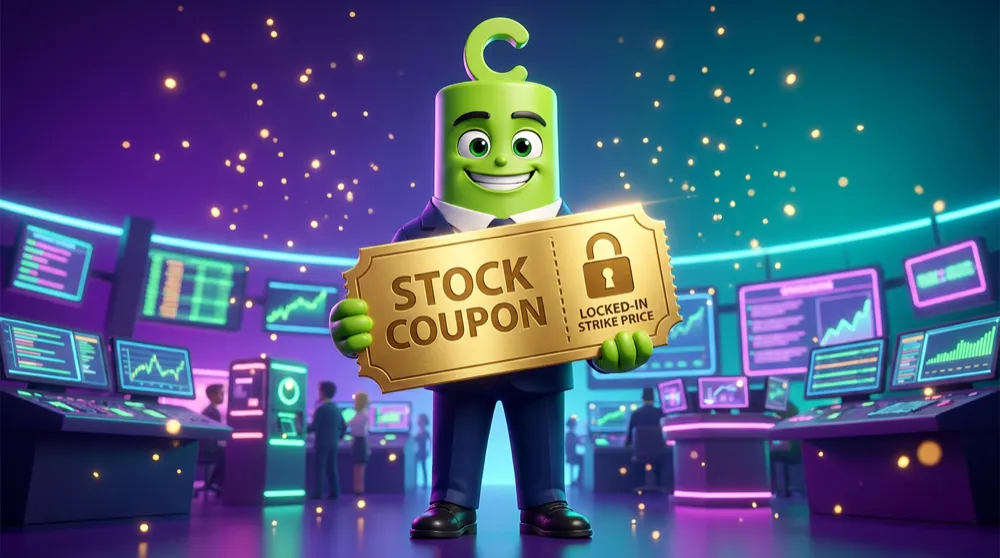
Every option — call or put — is stitched from the same four parts: the underlying (the stock it tracks, say NVDA), the strike (your locked-in price), the premium (what you pay to own it), and the expiration (the deadline before it dies). Learn those four words and the rest is just arithmetic.
The strike is the price you get to buy at. The premium is the fee you pay to get that right. Beginners swap them constantly — nail the difference now and half of options clicks into place.
The whole bet in one sentence
A call is your right — never your obligation — to BUY the stock at the strike. You buy one when you think price is heading up. That’s the entire thesis: the stock climbs above your strike, and the gap between where it lands and your strike is yours to keep.
Say NVDA trades at $100 and you grab a $100 call for a $5 premium. NVDA rips to $120. You can still buy at $100, so your right is instantly worth $20 a share — a $15 profit after the $5 you paid. That’s leverage pulling the weight: a tiny ticket riding a big move, since one call controls 100 shares for a fraction of their cost.

A call is a small, capped bet on a big, open-ended climb.
A rookie trap: thinking the stock just needs to pass your strike. It doesn’t. You paid a premium to get in, so price has to cover the strike and that premium before a single dollar is profit. Land in between and you still lose.
Where profit actually starts: breakeven
That line where you finally turn green has a name — breakeven — and the formula is refreshingly simple: strike + premium. Your $100 call cost $5, so breakeven sits at $105. Below it you’re red, losing only the $5 you risked. The moment price pokes above $105, everything from there up is pure upside.
For any call: breakeven = strike + premium. A $100 call at an $8 premium breaks even at $108 — the fatter the premium, the higher the bar the stock has to clear.
Two phrases traders throw around
You’ll hear these constantly, so own them now. In the money (ITM) means the stock is above your strike — your call holds real value. Out of the money (OTM) means it’s below — a coupon nobody would cash yet, worth only leftover time value. At the money is when the stock sits right on the strike. For a call, ITM is the good news.

And here’s the beauty of buying a call: the worst thing that can happen is you lose the premium — never a penny more. Capped downside, open-ended upside, controlled with a small ticket. That’s why long calls are where nearly everyone starts. Next up, we flip the whole thing on its head: what if you think a stock is about to fall? Meet the Put.