What is a Put?
The bearish bet — your right to sell

Read
The whole market is bleeding red — and one trader’s account is glowing green. On a down day, that’s almost always a put at work.
Last lesson, Call taught you how to profit when a stock climbs. The put option is the mirror image: it’s how you profit when a stock falls — and, as a bonus, how you protect the shares you already own.
If a call is a coupon to buy at a locked-in price, a put is a coupon to SELL at one. Think of it as an insurance policy: you nail down a price you’re allowed to sell at, and if the stock craters, you still get to unload it high. If the stock holds up, you’re only out what the policy cost.

The good news: a put is built from the exact same four parts as a call — underlying, strike, premium, expiration. Nothing new to memorize. The only thing that flips is your direction: instead of betting up, you’re betting down.
Strike and premium still rule everything. A call is the right to BUY (you want up). A put is the right to SELL (you want down). Same machine, wired in reverse.
The whole bet in one sentence
A put is your right — never your obligation — to SELL the stock at the strike. You buy one when you think price is heading down. Your thesis: the stock drops below your strike, and the gap between your strike and where it lands is yours to keep. It’s the cleanest way to go short with your risk capped from the start.
Say NVDA trades at $100 and you buy a $100 put for a $5 premium. Bad news hits and NVDA craters to $80. You still get to sell at $100, so your right is worth $20 a share — a $15 profit after the $5 you paid. The lower it falls, the more your put is worth.

A call adds the premium to breakeven. A put subtracts it. Mirror image, top to bottom.
Puts aren’t only for bears. Already own 100 shares of NVDA and nervous about a dip? A put lets you sell at the strike no matter how far the stock falls — a hedge that pays off exactly when your shares hurt. Bet on the drop, or insure against it. Both are valid.
Where profit starts: breakeven flips
For a call, the premium pushed breakeven up. For a put, it pulls breakeven down, because you profit as price falls. The formula: strike − premium. Your $100 put cost $5, so breakeven sits at $95. Between $95 and $100 you’re still red; only once price drops below $95 does every dollar down become profit.
Same trap as calls, flipped. The stock slipping past your strike doesn’t pay you yet — it has to fall far enough to cover the strike and the premium. A $100 put at an $8 premium breaks even at $92, not $100.
In the money — but upside down
Moneyness works just like it did for calls, only reversed. In the money (ITM) for a put means the stock is below your strike — real value. Out of the money (OTM) means it’s above your strike — only time value left. At the money is stock ≈ strike. So if NVDA rips up to $130, your $100 put goes OTM and you risk only the premium.
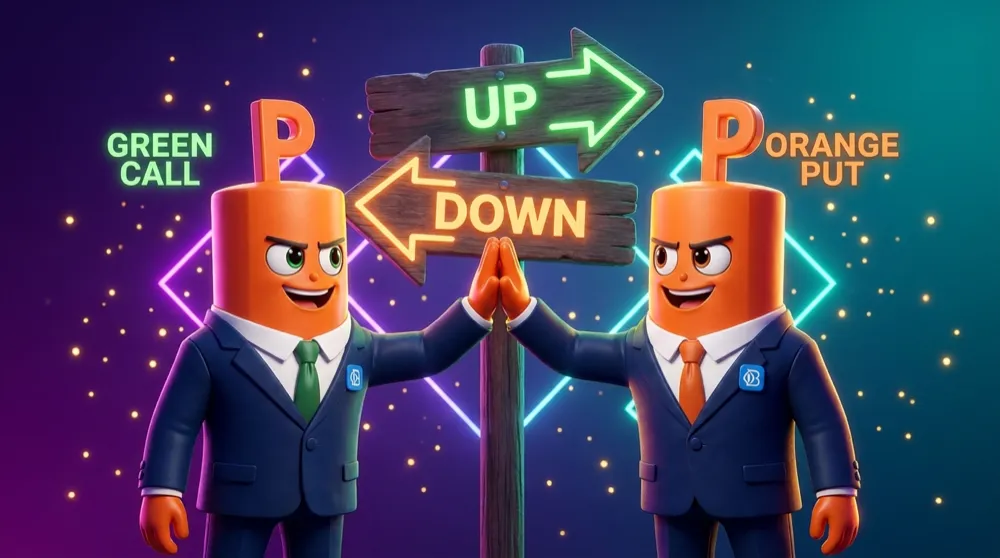
And like a long call, your max loss is the premium — never more, no matter how wrong you are. That’s the whole toolkit now: calls to bet up, puts to bet down, each with capped downside and a defined edge. Two option types down — from here on, you get to pick your side.