
Intrinsic vs Time value
What the premium is really made of

Read
Ever wonder why two options on the same stock cost wildly different amounts? Crack the premium into its two pieces and the mystery disappears.
Every option premium — the price you pay to own it — is secretly made of exactly two ingredients. Not three, not a dozen. Two. Learn to split them apart and you’ll finally understand why an option costs what it costs.
The two pieces are intrinsic value and time value, and they add up to the whole premium: premium = intrinsic value + time value. Always. That little equation is the entire lesson — the rest is just seeing it in action.

Premium = intrinsic + time value. If you know any two of the three, subtraction hands you the third. That’s the whole toolkit.
Intrinsic value — the real, cash-now part
Intrinsic value is what your option would be worth if you had to use it this very second. It’s the honest, here-and-now value — no hoping, no waiting. For a call it’s simply stock − strike; for a put it flips to strike − stock. And it can never dip below zero: if the math goes negative, intrinsic value is just $0.
Take a $100 call while NVDA trades at $112. Buy at $100, worth $112 — that’s $12 of intrinsic value, baked in and undeniable. Now the flip side: an out-of-the-money option has zero intrinsic value, because using it right now would gain you nothing. That’s a crucial line to hold on to.
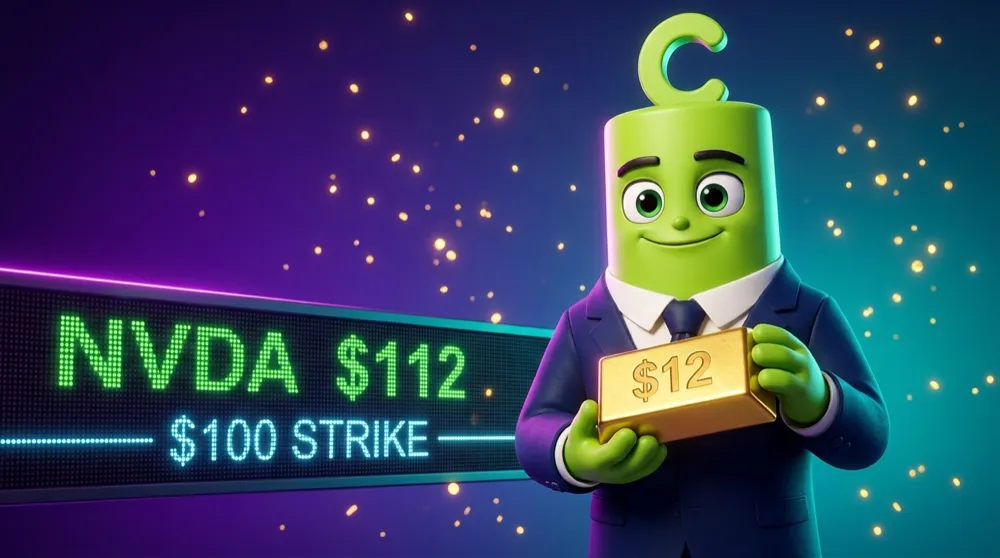
Intrinsic value is the part that’s real. Time value is the part that’s still just a maybe.
Time value — paying for the “maybe”
Time value is everything you pay above intrinsic — the price of the chance the stock keeps moving your way before the deadline. Rearrange the equation and it falls out: time value = premium − intrinsic value. If that same $100 call (with $12 of intrinsic) trades for $15, the extra $3 is pure time value. You’re paying three bucks for the “what if it climbs even more?”
And here’s the catch that trips up newcomers: time value decays. More time until expiration means more chances to move, so more time value. As the deadline creeps closer, those chances shrink — and the time value quietly bleeds toward zero.
Own an option and every day that passes with the stock standing still, a sliver of your time value evaporates. The stock doesn’t have to fall for you to lose — it just has to sit there while the clock runs.
Fast-forward to expiration and the picture gets brutally simple: time value hits zero. Gone. All that’s left is intrinsic value. If your option is in the money, it’s worth exactly its intrinsic value. If it’s out of the money, intrinsic is zero too — so it expires worthless, and you lose the premium you paid. That capped loss was the risk you signed up for from the start.

See a $9 premium on a call that’s $6 in the money? That’s $6 real, $3 hope. The bigger that hope slice, the more the clock can quietly take back before you’re proven right.
That’s the anatomy of a premium: real value plus a fading maybe. Now you can look at any price tag and know what you’re actually buying. Next up, we put it all together and read the full options chain — every strike, every premium, laid out like a scoreboard. 🎓