Moneyness: ITM, ATM, OTM
Where the stock sits vs your strike

Read
Traders throw around “in the money” and “out of the money” like everyone was born knowing them. By the end of this page, you will be.
Here’s the good news: moneyness is one of those words that sounds like finance homework but hides a dead-simple idea. It just answers one question — where is the stock sitting compared to your strike?
That single comparison tells you whether your option already holds real value, or whether it’s still a hopeful little bet waiting to pay off. Nothing more mysterious than that.
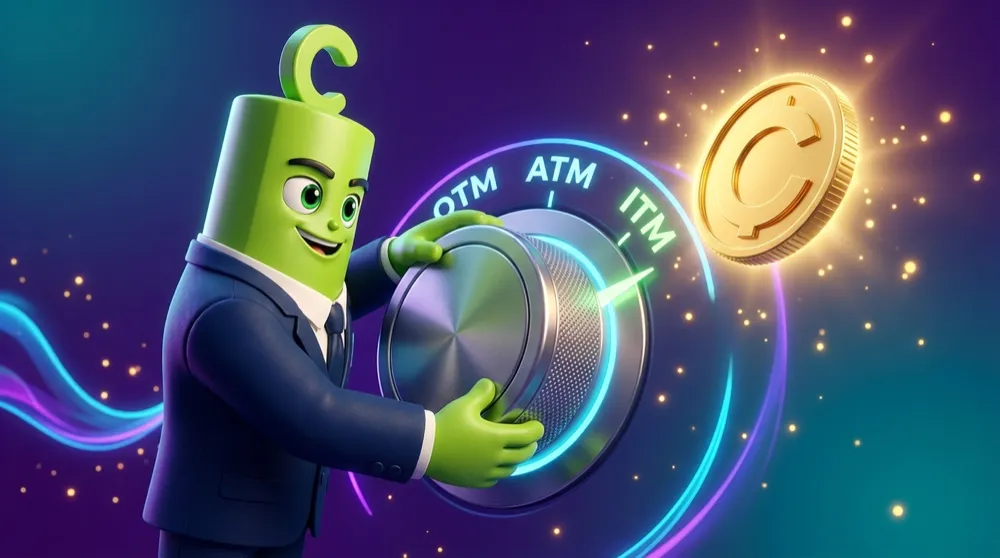
There are exactly three settings on the dial: in the money (ITM), at the money (ATM) and out of the money (OTM). Learn to place any option into one of those three buckets and you’ll read an options chain like a menu.
Moneyness is always stock price vs strike. It never touches the premium you paid. That’s a separate story — this is purely about where the stock is standing right now.
For a call, up is the good direction
A call is your right to buy at the strike, so a call is happiest when the stock climbs above it. Picture a $100 call while NVDA trades at $120. You get to buy at $100 something worth $120 — that gap is real, cashable value. Your call is firmly in the money.
Now drop NVDA to $80. Would you use your right to pay $100 for a stock you could grab for $80? Never. That call is out of the money — no built-in value yet, just the hope that price turns around before the deadline. And when the stock sits right around $100, hugging the strike, you’re at the money.
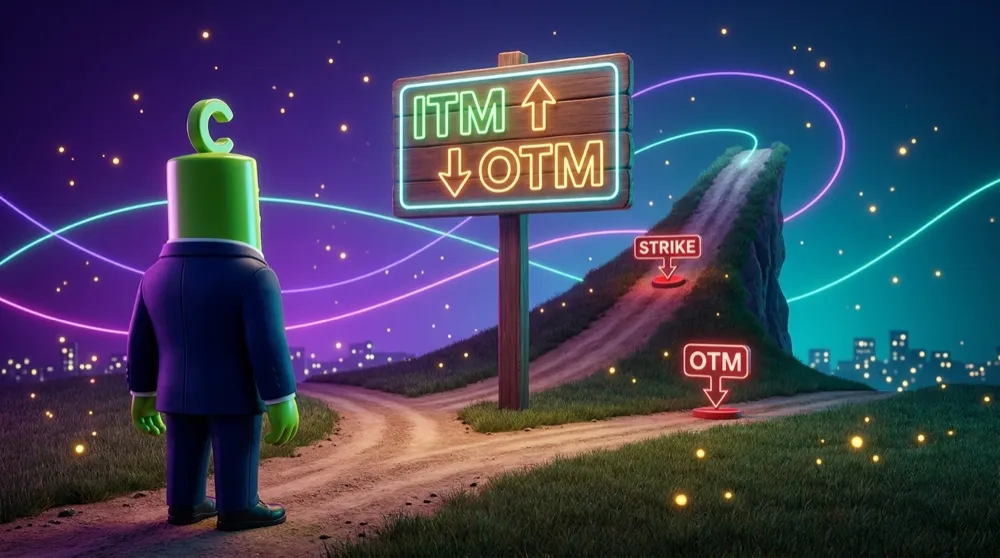
Moneyness isn’t about profit. It’s about position — where the stock stands relative to your strike.
An option can be in the money and you can still be down overall, because you paid a premium to get in. Moneyness describes the option’s value, not your P&L. Keep those two apart.
For a put, just flip the picture
A put is the right to sell at the strike, so everything mirrors. A put wants the stock below its strike. That same $100 strike with NVDA at $80 makes the put in the money — you can sell at $100 what’s only worth $80. Push NVDA up to $120 and the put falls out of the money. Same three labels, opposite direction.
An easy way to lock it in: calls want up, puts want down. Whichever direction your option is rooting for, moving that way pulls it into the money.

So why sweat over three little labels? Because moneyness is the dial that sets price and probability. An ITM option already has value baked in, so it costs more — you’re buying something closer to a sure thing. An OTM option is cheaper precisely because it’s a longer shot; you’re paying for a maybe. Push deeper ITM and the option starts behaving almost like owning the stock itself.
Deep ITM = expensive, high-odds, moves nearly dollar-for-dollar with the stock. Far OTM = cheap, low-odds, needs a real swing to pay off. Moneyness is the knob you turn between those two extremes.
That’s the whole idea. Glance at any option, compare stock to strike, and you instantly know if it’s in, at or out of the money — and roughly why it’s priced the way it is. Next up, we turn that value into a picture: the payoff diagram, and the exact line where you flip from red to green. 🎓