Buying & Selling Currency Pairs
Majors, crosses and exotics — how currencies trade two at a time

Read
Every forex price has two sides pulling against each other — and you are always on both.
Buy EUR/USD and you make a single move with two bets at once: long the euro, short the dollar. Currencies never trade alone — always two at a time.
There is no way to hold a currency on its own. Taking one always means letting go of another in the same instant, which is why forex is quoted in pairs and never singly.
Currencies are traded through a forex broker or CFD provider, and they are always traded in pairs — each currency quoted in relation to another.
EUR/USD is euros measured in dollars. GBP/JPY is pounds measured in yen. The pair is the unit of account here, not either currency in it.
So every order you will ever place names two currencies, and acts on both.
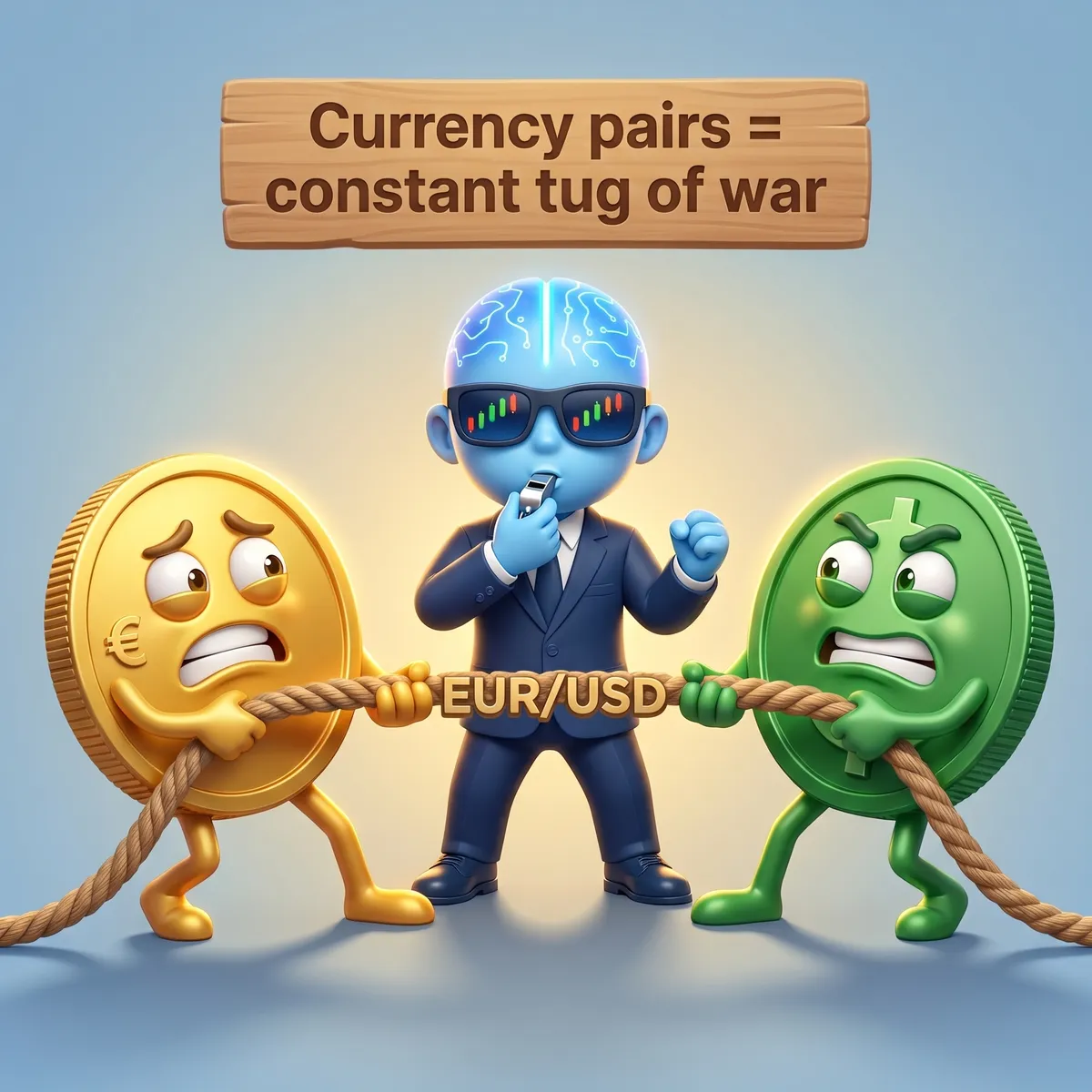
Picture each currency pair in a constant tug of war, each currency pulling on its own side of the rope.
What a quote gives you is a ratio, and a ratio moves when either half moves. That is why a strength reading tells you more than a single chart does.
Buying a pair is going long it; selling first is going short. Every forex trade is long one currency and short the other — one click, two positions.
There are three families of currency pairs:
1. The majors — always include the U.S. dollar.
2. The crosses — two majors, but no U.S. dollar.
3. The exotics — one major paired with an emerging-market currency.
Major Currency Pairs
What makes the list below the majors is one shared property: the US dollar is on one side of every single one. That is also why they are the busiest — the dollar is on one side of most of the market.
Eight currencies, seven pairs — and the missing one is not an oversight. The dollar cannot be paired with itself, so it makes seven partners out of the other seven.
Prices move more often on the majors than on crosses or exotics, which means more trading opportunities.
Currency Pair · Countries · Desk Nickname
EUR/USD — Eurozone / United States — “euro dollar”
USD/JPY — United States / Japan — “dollar yen”
GBP/USD — United Kingdom / United States — “cable”
USD/CHF — United States / Switzerland — “dollar swissy”
USD/CAD — United States / Canada — “dollar loonie”
AUD/USD — Australia / United States — “aussie dollar”
NZD/USD — New Zealand / United States — “kiwi dollar”
The majors are the most liquid pairs in the world. Liquidity is the level of activity in a market — how many traders are buying and selling, and the volume going through.
More people trade EUR/USD, at higher volumes, than AUD/USD — so EUR/USD is more liquid, with a tighter spread.
The spread is the toll — the small gap between the buy and sell price. It is what you pay to cross the market, so tighter toll = cheaper to trade.
Cross Pairs (the “minors”)
Pairs made of any two majors except the U.S. dollar are cross-currency pairs, or simply the crosses. Major crosses are also called minors.
Less traded than the majors, but still liquid enough to offer plenty of opportunities.
The test is mechanical, not a matter of judgement: no dollar, not a major. A pair of two heavyweight currencies with the dollar absent is a cross, however famous both halves are.
The most active crosses come from the three big non-USD currencies: EUR, JPY, and GBP.
Euro Crosses
EUR/CHF — “euro swissy” · EUR/GBP — “euro pound” · EUR/CAD — “euro loonie” · EUR/AUD — “euro aussie” · EUR/NZD — “euro kiwi” · EUR/SEK — “euro stockie” · EUR/NOK — “euro nockie”
Yen Crosses
EUR/JPY — “euro yen” or “yuppy” · GBP/JPY — “pound yen” or “guppy” · CHF/JPY — “swissy yen” · CAD/JPY — “loonie yen” · AUD/JPY — “aussie yen” · NZD/JPY — “kiwi yen”
Pound Crosses
GBP/CHF — “pound swissy” · GBP/AUD — “pound aussie” · GBP/CAD — “pound loonie” · GBP/NZD — “pound kiwi”
Exotic Currency Pairs
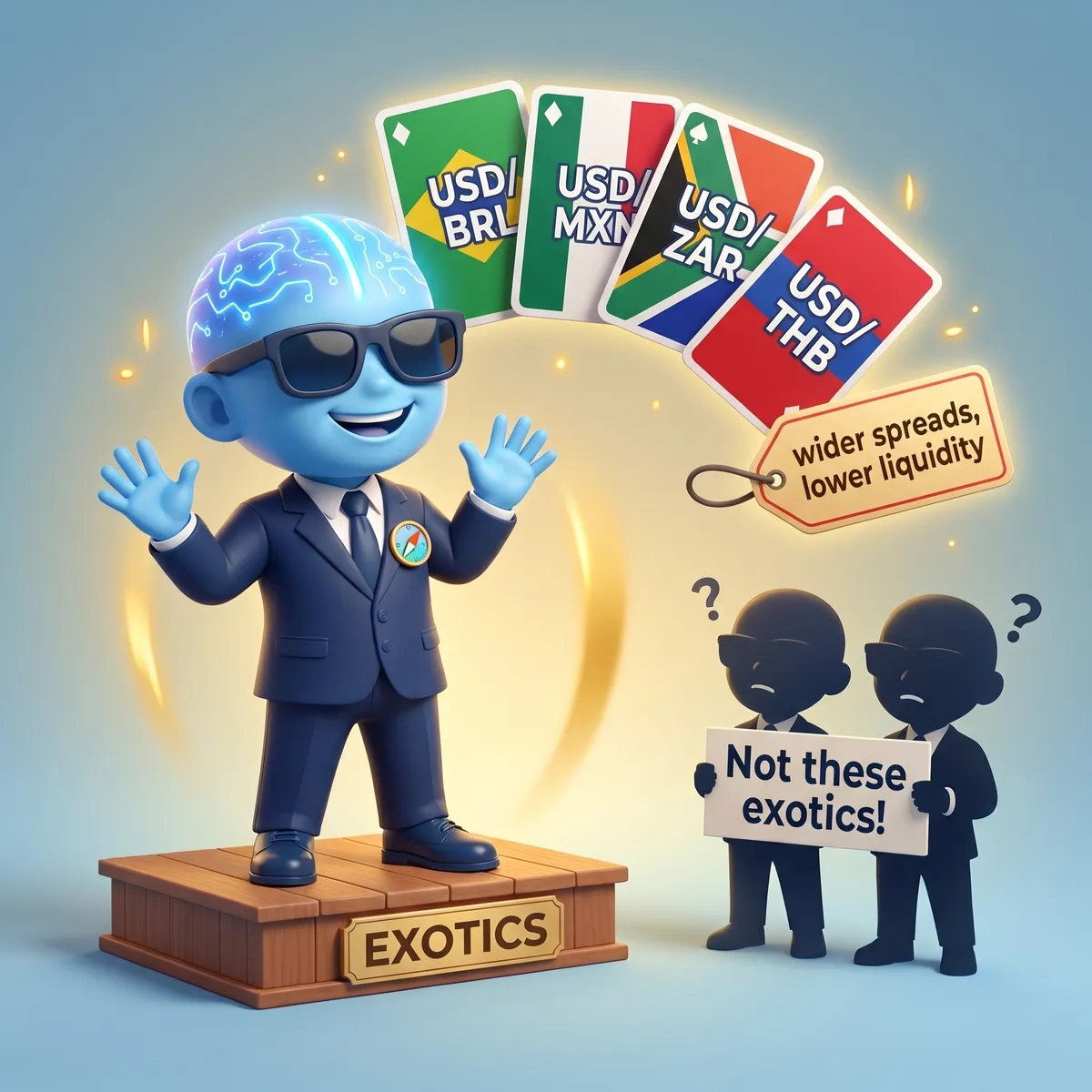
Pair a major with a currency from a smaller or faster-changing economy — the Brazilian real, the Mexican peso, the Polish zloty, the Turkish lira, the South African rand — and you have an exotic.
A few you may see, depending on your broker:
Currency Pair · Countries · Desk Nickname
USD/BRL — United States / Brazil — “dollar real”
USD/MXN — United States / Mexico — “dollar mex”
USD/ZAR — United States / South Africa — “dollar rand”
USD/SGD — United States / Singapore — “dollar sing”
USD/PLN — United States / Poland — “dollar zloty”
USD/THB — United States / Thailand — “dollar baht”
Exotics aren’t traded as heavily as the majors or crosses, so their spreads run two or three times wider than EUR/USD. Because liquidity is thin, their prices are far more sensitive to political and economic shocks.
Low liquidity means wide spreads and violent swings on political or economic news — an election surprise or a scandal can move an exotic pair hard. Treat exotics with caution as a beginner.
A round-turn is one full trade — open and close. You pay the toll on the round-turn, which is exactly why wide-spread exotics add up fast.
There are around 180 currencies in the world with their own ISO 4217 code — a lot of potential pairs. Not all are tradable, though; brokers typically offer up to about 70 currency pairs.
G10 Currencies
The G10 are ten of the most heavily traded — and most liquid — currencies in the world. Big players buy and sell them freely with minimal impact on the rate.
USD (US dollar) · EUR (euro) · GBP (British pound) · JPY (Japanese yen) · AUD (Australian dollar) · NZD (New Zealand dollar) · CAD (Canadian dollar) · CHF (Swiss franc) · NOK (Norwegian krone) · SEK (Swedish krona)
Every trade is a pair — long one currency, short the other. Majors always include the USD (seven of them); crosses join two majors without the USD; exotics pair a major with an emerging-market currency. Majors are the most liquid; exotics cost the most and swing hardest.
See you on the desk. — AI Mentor