The economic calendar
Knowing when the market holds its breath

Read
The market’s biggest jolts don’t sneak up on you. They’re printed on a timetable, to the minute. Here’s how to read it.
Imagine knowing, days in advance, the exact minute the market is about to lurch. You don’t need a crystal ball for that — you need a calendar. The economic calendar lists every scheduled report that can shake prices, down to the timestamp.
Big economic data doesn’t drop at random. Governments and agencies publish it on a fixed schedule set weeks ahead. Checking that schedule before you trade is the market equivalent of glancing at the forecast before you leave the house without an umbrella.

A 30-second scan of the calendar before the session flags every landmine on the day ahead. That’s not fancy analysis — it’s just refusing to get ambushed by a report you could have seen coming.
The heavyweight reports
Hundreds of numbers get released every month, but only a handful move nearly everything at once. Learn these three names and you’ve covered most of the drama:
The rate decision — when the central bank sets the price of money itself. Inflation (CPI) — how fast the cost of everyday goods is climbing. And the jobs report — how many people found or lost work. When one of these lands, the whole market flinches in the same instant.
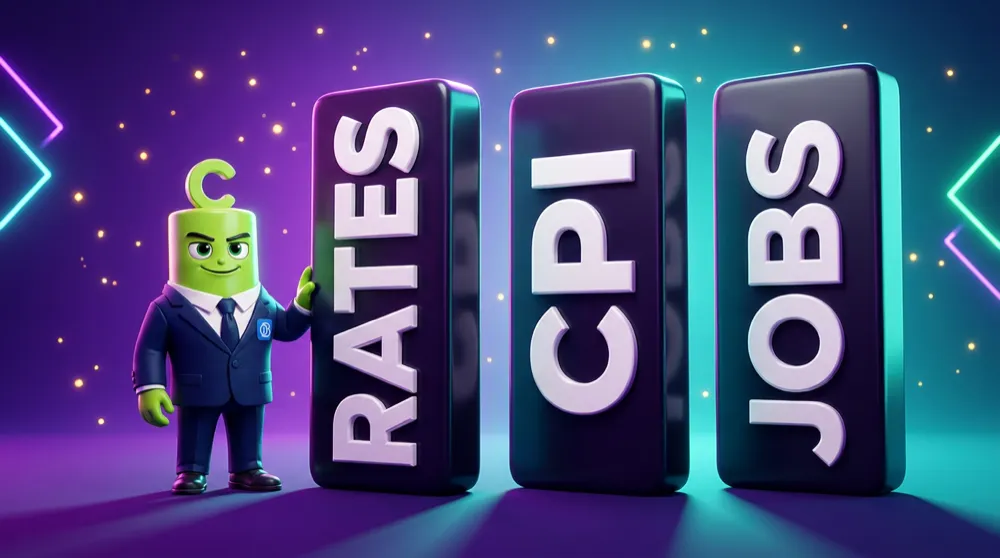
Rates, inflation, and jobs feed into almost every business at once — borrowing costs, consumer spending, and profits all bend around them. That’s why a single line of data can move thousands of stocks together.
Forecast vs actual: where the move hides
Every scheduled number arrives with a crowd forecast already stitched into prices. Analysts guess, traders position, and the expected figure gets quietly priced in ahead of time. So when the report drops, the raw number isn’t the story.
The number itself is old news the moment it’s expected. The distance from the forecast is the news.
Come in exactly at forecast and the reaction is often a shrug — everyone already braced for it. Miss the forecast, high or low, and you get the sharp, fast move as the market scrambles to reprice a surprise it wasn’t ready for.
The calendar flags when volatility is likely — it can never tell you the direction. Anyone who claims to know exactly which way CPI will send the market is guessing. Its job is preparation and timing, not prediction.
Turning it into a routine
Reading the calendar is a tiny four-step loop. Check the release time. Note the crowd forecast beforehand. Watch the actual number land. Then react to how far it missed. Chaos becomes something you can rehearse.

Some traders duck out entirely around the biggest reports, wary of the wild first seconds. Others wait for the dust to settle and trade the direction the surprise revealed. Either way, they chose — because they saw it coming. That’s the whole point of the calendar: to trade on purpose, not by ambush. Next up: reading the crowd’s mood itself. 🎓