The three types of analysis
Technical, fundamental & sentiment

Read
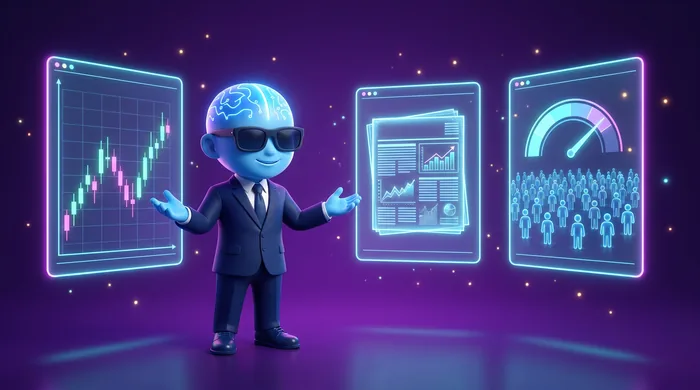
Every trader is answering one question: up or down? There are three lenses you can look through to answer it, and each one sees something the others miss.
AI Mentor here. 🧠 Strip away the jargon and every trader is really asking the same thing: is this about to go up, or down? What separates traders is not the question — it is the lens they look through to answer it. There are three, and the arguments about which one is "right" have been running for a century. They are the wrong argument.
Technical: what is price doing?
Technical analysis reads the price and the chart itself — trends, support and resistance, patterns, and indicators like moving averages or RSI. It deliberately does not ask *why* price moved. It asks what price is doing right now, and where it has tended to react before.
The assumption underneath is neat: everything the crowd knows is already baked into the price, so the chart is the summary. You do not need the news if you can read the tape.
Looks at: price action, levels, patterns, indicators. Asks: "What is price doing?" Best for: timing your entries and exits.

Fundamental: what should it be worth?
Fundamental analysis looks behind the currency at the economy driving it — interest rates, growth, inflation, employment, and above all central-bank policy. A currency tends to strengthen when its central bank raises rates or its economy runs hot.
This lens asks what a currency *should* be worth based on the real world, not what the chart is doing this minute. It is slow, and it is often early — which is exactly why it is bad at timing and good at direction.
Looks at: rates, growth, inflation, central banks, news. Asks: "What should it be worth?" Best for: setting your directional bias.
Sentiment: what is everyone else doing?
Sentiment analysis measures how the crowd is positioned and feeling. Are markets in a confident *risk-on* mood, buying higher-yielding and riskier currencies? Or a fearful *risk-off* mood, fleeing to safe havens like the US dollar, the yen or the Swiss franc?
There is a second, sharper use. If almost everyone is already long a pair, ask who is left to buy. A crowded trade has no fuel behind it, and it can snap back hard when the last buyer runs out.
When everyone is on one side of the boat, the interesting question is not whether they are right. It is what happens when they move.
Looks at: crowd positioning, risk-on vs risk-off mood. Asks: "What is everyone else doing?" Best for: judging risk and spotting crowded trades.

No single lens wins
Here is the part the century-long argument keeps missing: none of the three is best, because they answer different questions. Most professionals blend all three, and the recipe is usually the same.
Use fundamentals to pick your direction. Use technicals to time the entry and the exit. Use sentiment to judge how crowded — and therefore how dangerous — the trade already is.
A setup where the fundamentals point up, the chart offers a clean entry, and the crowd is not already piled in is a high-conviction trade. Those are rarer than you would like, which is exactly why they are worth waiting for.
Try all three pairs of glasses on the same chart. You will notice they do not contradict each other nearly as often as their fans do. 👓