Synthetic positions
Rebuilding stock out of options — like LEGO

Read
Options are LEGO bricks. Snap the right ones together and you can rebuild the stock itself — long or short — without ever touching a single share.
Here is a quietly powerful idea: two positions that always end with the same profit and loss are financially identical, no matter how they are built. The market does not care about the path — only the payoff. And options let you assemble a payoff that behaves exactly like owning stock, or shorting it, out of nothing but calls and puts.
These look-alikes are called synthetic positions. Same destination, different road. Once you see them, the options board stops looking like a jungle and starts looking like a box of interchangeable bricks.

Synthetic long stock: buy a call, sell a put
Buy a call and sell a put at the same strike and expiration, and your combined payoff is a straight line — identical to owning 100 shares. If the stock rises, the long call profits. If it falls, the short put takes the loss. Up or down, dollar for dollar, you mirror the stock perfectly.
That is synthetic long stock, assembled purely from options. No shares changed hands, yet you carry exactly the same risk and reward as a shareholder. Long call plus short put at one strike equals a stock in disguise.
Real stock has a straight-line payoff — gain a dollar for every dollar up, lose one for every dollar down. Long call + short put at the same strike draws that exact same line. Same shape = same position.
Put-call parity: the law behind the magic
There is an iron rule tying calls, puts and stock together. At the same strike and expiry, a call minus a put equals the stock minus the strike (adjusted for time). This is put-call parity, and it is the grammar of options. It means every piece can be rebuilt from the others — stock from options, a put from a call and stock, a call from a put and stock.
Break the rule and the prices drift out of line — but not for long. Arbitrageurs pounce on the mispricing and buy the cheap side, sell the rich side, and pocket the difference until everything snaps back into balance. Parity is enforced by an army of traders hunting free money.
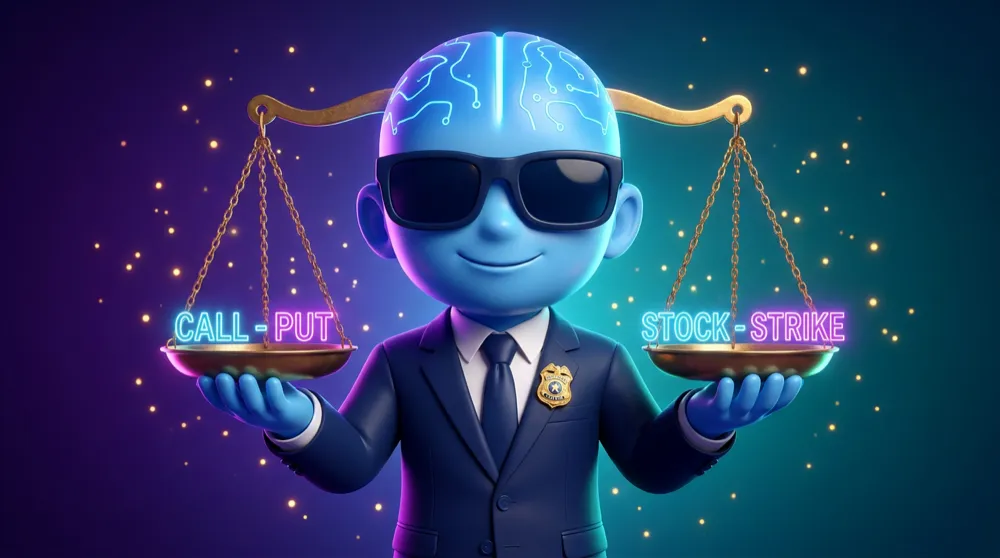
Parity is the grammar of options. Every synthetic is just the same sentence rearranged.
Synthetic short stock: flip the legs
Reverse the pieces — sell a call and buy a put at the same strike — and you get synthetic short stock. It profits when the stock falls and loses when it rises, exactly like shorting real shares. Same LEGO bricks, mirrored blueprint.
Why bother? Because sometimes shorting the actual stock is hard, expensive to borrow, or outright restricted. The synthetic does the same job through the back door, using options that are freely available when the shares are not.
Long call + short put = synthetic long stock. Short call + long put = synthetic short stock. Long stock + long put = synthetic long call (a protective put in disguise). Flip the legs, flip the direction.
Why this matters in the real world
Synthetics are not just a party trick. They let you sidestep hard-to-borrow stock, hunt tiny mispricings between a real leg and its synthetic twin, and — maybe most usefully — understand what you already trade. A “protective put” (long stock plus a long put) has the exact same payoff shape as a long call. They are the same position wearing different clothes.
Once positions become interchangeable payoffs in your mind, strategy names stop mattering and shapes take over. That is the shift from memorising recipes to actually cooking.
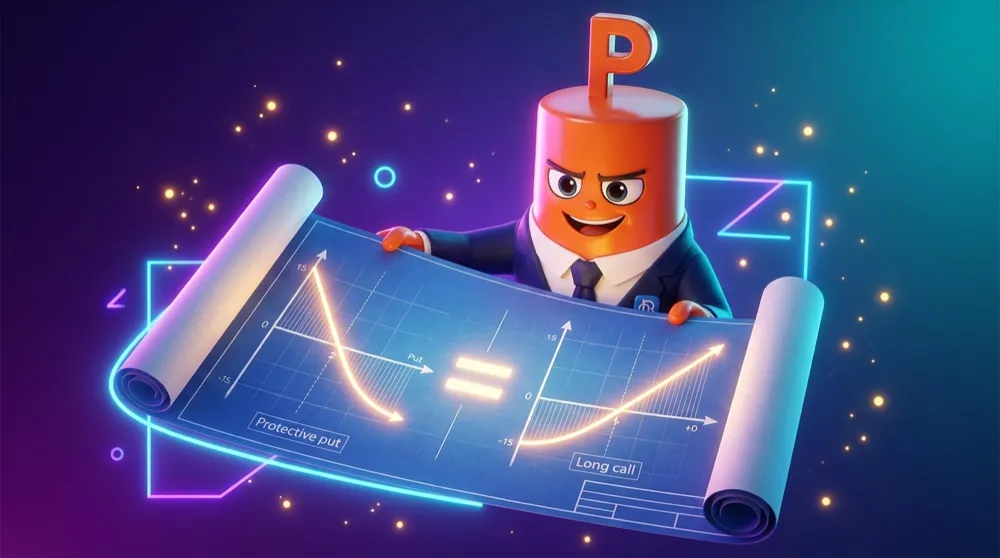
Synthetics match the payoff shape, but real-world frictions — dividends, borrow costs, early assignment, financing — can make the “identical” legs behave a little differently. The theory is clean; the plumbing has quirks.
Call minus put equals stock minus strike — that one law unlocks every synthetic on the board. For our finale, we learn to reshape a live trade instead of just watching it: adjusting and rolling. 🧱